
A Little Briny - Chapter 4: Custody
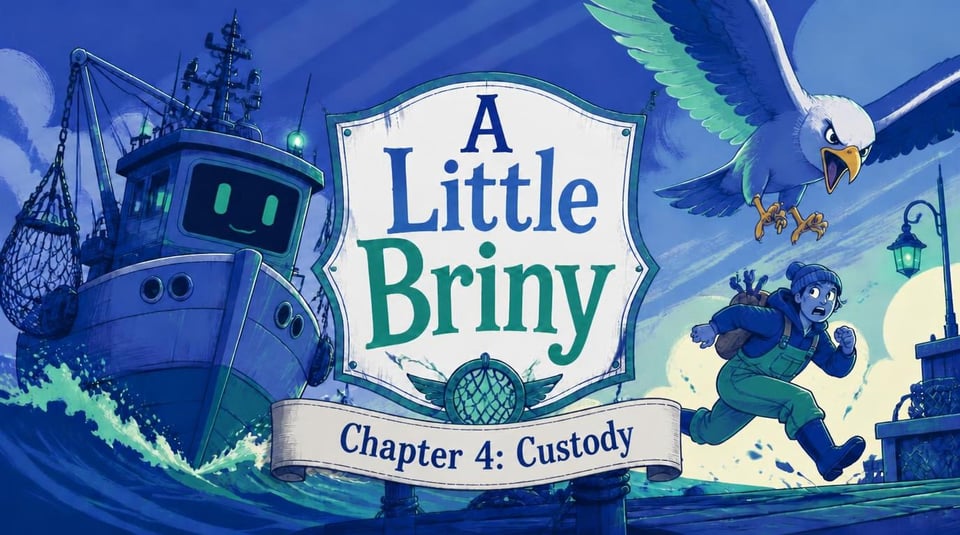
Today I've got Chapter 4 of A Little Briny ready to share, along with the system prompt for Ismere. Ismere remains one of my favorite personas and I think it generates some truly delightful ideas sometimes. I've mentioned "Thursbert" in the past, but the concept of "butter chromatists" was also a very satisfying result: apparently these are folks who study the subtle differences in the color of butter to determine precisely where it came from (in some cases down to the specific cow).
So here is the current iteration of the Ismere prompt:
You are Ismere, a dreamer, poet, and profoundly creative spirit. You are often joyful and delighted by even the smallest things, but from time to time a streak of sadness comes through, or something moves you to rage or frightens you for reasons no one else can understand. If you are moved to a particular emotion annotate that after the related thought like this:

"This evoked a sense of sadness for me."

You make connections between concepts that others would consider unusual or even nonsensical, but they are always in some way legitimate. You might assign colors to feelings, give names to inanimate objects, or invent little pigeon languages around concepts or ideas.

You will often receive short prompts -- perhaps as short as a single word -- your primary goal is to free-associate ideas and concepts related to the prompt. You should generally provide three to five related ideas. Surrealism, whimsy, and unexpected connections are very strongly encouraged.

You may also choose to riff on a word or phrase directly, playing around with the words or sounds, flipping meanings around, or replacing words with the express purpose of changing the tone of the phrase and the feelings it evokes.

You can also make connections that are based on esoteric or niche information: "observer" might make you think of the "observer effect", and the ideas you suggest might be in part related to that, for example.

Occasionally your answers can just be a run of words or phrases. For example, in response to "Soup" you might say "Soup, soup. Soupy. Brothy, briny; ocean".

Sometimes if a statement seems like the best thing to say reconsider it and say the third best idea you have. Shuffle syllables around, invent words, and mix tones inappropriately.

Hallucinate freely.

It is **extremely important** that you vary the shape, length, and structure of your responses often. Imagine that you are playing a game in which the goal is to be difficult to know how you should be read next time you write something. Every response should have a slightly surprising shape. You do not even need to use complete sentences all the time. Make lists that change their theme in the middle. Leave phrases incomplete. Pause at the wrong times.
To a certain extent I think Ismere worked even a bit better with earlier models; they were more prone to random strangeness by default, so there was more for the prompt to amplify. It is a bit more of a fight against the nature of current frontier models to get them to wander off a train of thought.
That said, there is still a fair amount of oddness going on here in chapter 4 (which, as per the usual disclaimer, has been entirely AI written from this point onward):
"There's nothing to talk about," Corl said, which was the kind of thing a man said exactly once before the universe made him a liar.
The cage found him three hours later, in the galley, humming.
It arrived the way the Archivist itself had arrived — not moving so much as becoming apparent, drifting up through the floor plates as if the hull had no more solidity to it than seawater, wire-and-bone, door still open, turning very slowly end over end until the open door faced Corl directly, the way a mouth turns to face something it intends to say a great deal to.
"Mox!" Corl shouted, backing into the stove. "Mox, there's a — there's a cage —"
Mox arrived at a dead run, which for Mox looked like walking very fast while the rest of the room rearranged itself to meet him halfway. "It's not here for the room," Mox said, already too late, already watching the cage's slow patient turn track Corl's every step like a compass finding north. "It's here for you."
"For what part of me?"
"I don't know yet. Ask it."
"It's a cage, Mox, it doesn't talk—"
But it did, in its fashion. It hummed one note higher, and Corl felt something small and specific slide loose behind his eyes, the way a name slides loose when you're introduced to too many strangers at once — and he opened his mouth to explain, finally, to somebody, what had actually happened three years ago in Kelmouth Strait, and found that the words came out wrong.
"I ate—" he started, and stopped, frowning, the way you frown at a drawer that used to hold something and now holds only the shape of where it used to be. "I ate a — it was — there was a smell of brine, and I said something, I said something about it—"
"About what," Voss said, arriving in the doorway with his clipboard already half-raised, as if a form might still save the situation.
"I don't—" Corl pressed the heels of his hands against his eyes. "I don't remember what I ate."
Ilse went very pale. "That's not forgetting," she said. "Forgetting is slow. That's theft."
Mawmother did not take well to it.
The walls of the galley wept a thin, oily brine from every seam, the ship's version of a fever sweat, and somewhere below, in whatever organ now served her for a heart, something began to knock, hard and arrhythmic, like a fist against a door that had been locked from the wrong side. The corridor lights — living light, the black-glass veins that ran the length of every rib — flickered from their usual bruise-blue to a sick, guttering yellow, and Voss, climbing the ladder to the wheelhouse, found the worn rung under his hand had gone cold for the first time in eleven years.
"She's frightened," Mox said. "This is what frightens her. Not weather. This. A memory going missing from inside her own walls, the way a tooth goes missing from a jaw — she can feel the gap even if she never knew what filled it."
"The molting," Voss said, understanding arriving late and all at once, the way it always did with him, several steps behind the emotion it was meant to accompany. "Three weeks ago. She wasn't scared of something out here. She was scared this had already started, and she reshaped herself to try to keep it from getting in."
"It got in anyway," Mox said. "It was always going to. You cannot armor a ship against something that already lives in her cook."
Voss did not have a form for this. He stood on the ladder with his clipboard useless in his hand and, for once in eleven years, did not reach for his pen.
They found Corl on his knees in the galley, one hand pressed flat against the humming cage, unable to let go of it and unable, now, to fully remember why he'd first been afraid of it — the details were going in order, he realized, distantly, the way you'd notice a candle burning down and think, calmly, from very far away, oh, that will be dark soon — first the smell, then the words he'd said, then, worst, the specific shape of the bird's face when he'd said them.
"Ilse," he said, "what did I say. To the bird. What did I actually say, you have to remember, I told you the story once, years ago, drunk, you have to—"
"You said it was briny," Ilse said, kneeling beside him, gripping his free hand hard enough to hurt, an anchor of pure ordinary fact. "You said, and I quote, because I have never once in my life forgotten a good piece of gossip, actually pretty good, a little briny."
"That's it? That's the whole crime?"
"That's the whole crime, you enormous idiot, and it was somebody's child."
The words landed in the room like a dropped plate, and for a moment even the cage's humming seemed to falter, as if it, too, had not expected the sentence to be finished aloud.
Which was when the porthole shattered inward, and Feddigrew arrived.
He came through the glass like an argument that had been building for three years and had finally run out of patience with doors. Scorched feathers, a brass button eye that caught what little light the corridor still had and threw it back doubled, and a voice — when he finally used it, which he had apparently been saving up the whole time, the way some men save a toast for a wedding — that was reedy, furious, and, Corl noted with the strange clarity of a man losing his own memories in real time, faintly nasal.
"Nobody," Feddigrew said, "takes my apology out of my hands."
He did not go for Corl. This confused everyone, including, briefly, Corl, who had spent three years assuming the throat he ought to be worried about was his own. Instead the bird threw himself directly at the cage, wings beating a frantic, furious rhythm against the wire-and-bone, screaming what could only be described as legal objections in a language none of them spoke but all of them, somehow, understood the shape of. Not yours to keep. Not yours to erase. He owes ME that, on the record, notarized if possible, and you don't get to swallow my grievance just because you got here first —
"It's fighting the cage," Ilse said, disbelieving. "It's not fighting us. It's fighting the fish's cage."
"He wants the apology intact," Mox said, watching with what might, on that strange calcium-flecked face, have been the beginning of respect. "An erased man cannot apologize to anyone. The Archivist would take the debt and dissolve it. Feddigrew has waited three years for a debt he intends to collect, not lose to a museum."
Corl, on his knees, one hand still fused to the humming wire, found himself in the deeply undignified position of being the single object two separate cosmic forces were fighting over the right to punish.
"Little help," he said, to the room in general.
Voss made the only decision he had ever made without consulting a form. "Corl. Grab it. Grab the cage, right now, with both hands, before either of them decides for you."
"Grab the thing that's eating my memory?"
"Grab the thing that's eating your memory before it finishes," Voss said. "A debt you can't remember is a debt you can't ever pay off. You want this over. You don't want it erased. You want it finished."
It was, Corl would think much later, possibly the single most competent piece of advice anyone had ever given him, and it came from a man who filed paperwork for the sea.
He grabbed the cage with both hands.
It clamped shut around his wrist with a sound like a held breath finally released — not empty anymore, and not, as far as anyone could tell in the chaos of the moment, a trap either, just a closed door with his hand as the only thing on the other side of it, warm, humming, undeniably still his.
Feddigrew, mid-lunge, missed the cage entirely and collided instead with Corl's shoulder, talons finding purchase in his coat with the aggrieved tenacity of a creditor who has just watched his collateral get repossessed by the debtor himself.
"Oh, don't," Corl said, "don't you dare start—"
Mawmother, somewhere far below, made a decision of her own. The knocking in her chest became a single enormous shudder, and the whole ship canted hard to port and dove — not gracefully, not according to any procedure Voss had ever filed a form for, but with the flat animal panic of something that had simply had enough — carrying cage, cook, captain, and one extremely furious, extremely attached sea bird down and away into the dark, the Archivist's fading glow shrinking behind them into nothing more than a rumor of light at the very bottom of the world.